Double Jersey Interlock Circular Knitting Machine: Advancing High-Quality Fabric Production
In today's fast-evolving textile manufacturing industry, efficiency, precision, and fabric performance have become the core drivers of competitiveness. Among the wide range of textile machinery, the Double Jersey Interlock Circular Knitting Machine has emerged as one of the most essential technologies for producing premium knitted fabrics. Known for its ability to create stable, smooth, and highly elastic textile structures, this machine plays a critical role in modern garment production, home textiles, and industrial fabric applications.
Recent market analysis indicates that global demand for interlock fabrics has grown by approximately 15% over the past two years, driven by rising consumption of comfortable apparel, sportswear, and functional textiles. This increasing demand has placed greater emphasis on advanced knitting machinery capable of delivering consistent output, higher productivity, and superior fabric quality.
Double jersey interlock circular knitting machines are designed to meet these expectations. By utilizing two synchronized needle beds—cylinder and dial—they produce a tightly interlocked fabric structure that offers excellent dimensional stability, softness, and durability. However, while the technology is highly efficient, manufacturers still face challenges in maintenance, operational stability, and production optimization. As a result, selecting the right machine and maintaining it properly has become a key concern in the textile industry.
The Double Jersey Interlock Circular Knitting Machine is an advanced textile machine engineered to produce interlock fabrics using a dual-needle bed system. Unlike single jersey machines, interlock machines utilize both cylinder and dial needles working in precise synchronization.
The fundamental principle of operation is based on interlocking two sets of yarn loops, resulting in a fabric structure that is thicker, smoother, and more stable than standard single jersey fabrics. This structure eliminates curling at the edges and enhances fabric strength, making it ideal for high-end applications.
A modern interlock knitting machine can typically produce 200 to 300 kilograms of fabric per day, depending on yarn type, machine diameter, gauge, and operating conditions. This high output capacity makes it a preferred choice for large-scale textile manufacturers aiming for consistent productivity.
Despite its advantages, achieving optimal performance requires proper machine setup, skilled operation, and regular maintenance. Even minor mechanical deviations can affect fabric uniformity, leading to quality inconsistencies or production delays.
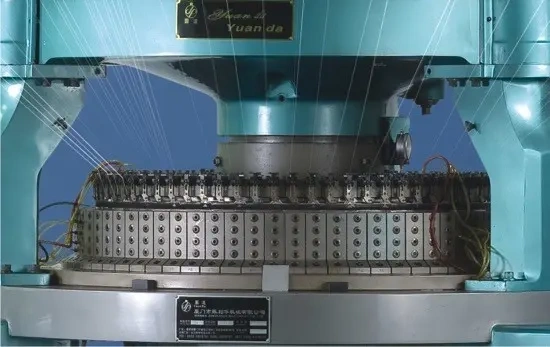
The working mechanism of a Double Jersey Interlock Circular Knitting Machine is more complex than standard circular knitting machines. It involves the coordinated movement of long and short needles positioned alternately in the cylinder and dial beds.
Originally, interlock machines were designed with two different needle lengths. Long needles operate in one cam track, while short needles function in another cam track closer to the needle heads. These needles are arranged in an alternating pattern, ensuring precise loop formation and interlocking during the knitting process.
At the first feeder, long needles in both cylinder and dial beds engage in knitting. At the second feeder, short needles take over the knitting process. The non-active needles follow a controlled run-through path, ensuring continuous fabric formation without interruption.
This alternating mechanism allows the machine to produce a tightly structured fabric with:
- High elasticity
- Smooth surface texture
- Excellent shape retention
- Reduced fabric curling
- Enhanced durability
Because of these characteristics, interlock fabrics are widely used in underwear, sportswear, casual wear, fashion textiles, and industrial applications.
Modern Double Jersey Interlock Circular Knitting Machines are designed with advanced mechanical and electronic systems to ensure precision, stability, and durability. One of the key structural features is the cam system configuration.
The machine typically includes:
- Two tracks of cams on the dial plate
- Four tracks of cams in the cylinder
By adjusting the cam positions, operators can produce a variety of fabric structures, including:
- Twill patterns
- Interlock fabrics
- Air-layer fabrics
- Small jacquard interlayer structures
- Bubble textures
- Crepe-style fabrics
- Pique fabrics
- Standard knitted cloth
Additionally, when equipped with lycra feeders and elastic yarn attachments, the machine can produce stretchable double jersey fabrics, which are widely used in performance sportswear and fitted garments.
This flexibility significantly enhances production versatility, allowing manufacturers to respond quickly to changing market trends.
The fabrics produced by Double Jersey Interlock Circular Knitting Machines are widely used across multiple industries due to their unique properties. Their smooth surface, elasticity, and durability make them suitable for both fashion and functional applications.
Interlock fabrics are extensively used in:
- T-shirts
- Undergarments
- Baby clothing
- Sportswear
- Casual wear
Their softness and comfort make them ideal for garments that are worn close to the skin.
Due to their stretchability and moisture-handling capabilities, interlock fabrics are widely used in:
- Yoga wear
- Gym clothing
- Running apparel
- Compression garments
Interlock fabrics are also used in:
- Bed linens
- Pillow covers
- Upholstery fabrics
- Cushion covers
In certain cases, interlock fabrics are used in:
- Automotive interiors
- Protective clothing layers
- Technical textile components
This wide range of applications demonstrates the machine's importance in modern textile production ecosystems.
Modern interlock knitting machines are built with high-quality materials and advanced engineering techniques to ensure long-term performance and operational stability.
The machine cylinder is often made from stainless steel imported from Japan, ensuring excellent durability, corrosion resistance, and machining precision. This enhances overall machine life and ensures consistent fabric quality.
The bed plate of the machine utilizes a steel ball runway structure with oil immersion lubrication. This design ensures:
- Smooth operation
- Reduced friction
- Low noise levels
- High wear resistance
As a result, the machine operates more efficiently with reduced maintenance requirements.
The drive components are manufactured using high-grade materials and undergo advanced heat treatment processes to improve strength and durability. Key elements include:
- Precision gears manufactured in Taiwan
- High-quality bearings imported from Japan
- Reinforced transmission components
- This combination ensures:
- High transmission accuracy
- Stable machine operation
- Reduced vibration
- Extended service life
One of the most important advantages of modern interlock machines is their ability to operate with minimal noise. This is achieved through precision engineering, balanced mechanical systems, and optimized lubrication.
Thanks to the synchronized movement of cylinder and dial needles, the machine ensures:
- Consistent loop formation
- Uniform fabric density
- Minimal defects
- High production consistency
The Double Jersey Interlock Circular Knitting Machine is designed for high-volume production environments. Depending on configuration and yarn type, it can achieve daily output levels of 200–300 kg of fabric.
However, actual production efficiency depends on several factors:
- Machine speed settings
- Yarn quality
- Operator skill level
- Maintenance frequency
- Environmental conditions
When properly maintained, the machine can operate continuously for long production cycles without significant downtime.
Despite its advanced design, interlock knitting machines require regular maintenance to maintain performance. Many manufacturers encounter challenges such as:
- Yarn tension inconsistency
- Needle wear and breakage
- Cam misalignment
- Lubrication issues
- Dust accumulation in mechanical parts
Failure to address these issues can result in:
- Reduced fabric quality
- Increased machine downtime
- Higher production costs
- Delayed order fulfillment
To avoid these problems, manufacturers are encouraged to implement preventive maintenance schedules, including:
- Regular lubrication checks
- Needle replacement cycles
- Cam system inspection
- Cleaning of yarn feeding systems
- Drive system calibration
Proper maintenance not only extends machine lifespan but also ensures stable production output.
The global textile machinery market is experiencing steady growth, driven by increasing demand for high-quality fabrics and automated production systems. Several key trends are shaping the future of interlock knitting machines:
Modern machines are increasingly integrated with computerized control systems, allowing for:
- Automated pattern adjustment
- Real-time monitoring
- Reduced manual intervention
Manufacturers are focusing on reducing energy consumption through:
- Optimized motor systems
- Improved transmission efficiency
- Low-friction mechanical designs
With rising demand for sportswear and performance textiles, interlock machines are being optimized to produce:
- Moisture-wicking fabrics
- Stretchable materials
- Lightweight yet durable textiles
- Industry 4.0 integration is enabling:
- Predictive maintenance
- Data-driven production optimization
- Remote machine diagnostics
These trends indicate that interlock knitting machines will continue to evolve toward smarter, faster, and more efficient systems.
The Double Jersey Interlock Circular Knitting Machine remains a cornerstone of modern textile manufacturing. Its ability to produce high-quality, durable, and versatile fabrics makes it indispensable across multiple industries, from fashion to technical textiles.
With growing global demand for interlock fabrics and continuous advancements in machine technology, manufacturers are increasingly investing in high-performance knitting systems that offer stability, efficiency, and flexibility.
While operational challenges such as maintenance and consistency still exist, modern engineering improvements and smart manufacturing solutions are helping overcome these issues. As a result, the interlock knitting machine continues to play a vital role in shaping the future of the textile industry, ensuring higher productivity and superior fabric quality for global markets.
