Double Jacquard Circular Knitting Machine: High-Efficiency Solution for Complex Fabric Designs
The textile industry continues to evolve rapidly as manufacturers pursue greater efficiency, creative flexibility, and high-quality fabric production. With the growing demand for complex knitted structures in fashion, home textiles, and industrial fabrics, advanced knitting technologies have become essential for maintaining competitiveness. Among these innovations, the Double Jacquard Circular Knitting Machine has emerged as a powerful solution for producing intricate double jacquard fabrics with exceptional precision and productivity.
Designed to combine advanced electronic control systems with robust mechanical engineering, this machine enables textile manufacturers to create sophisticated patterns, textures, and fabric structures. It supports a wide range of applications, including clothing fabrics, bed sheets, pillow towels, children's textiles, mattresses, and other home textile products.
Modern double jacquard machines offer full electronic needle selection on both the dial and cylinder, unlocking extensive design possibilities while maintaining high production speeds. As the textile industry moves toward automation, customization, and high-value fabric production, the double jacquard circular knitting machine plays an increasingly important role in meeting these evolving demands.
This article explores the working principles, features, benefits, applications, technological advancements, and future trends of double jacquard circular knitting machines in today's textile industry.
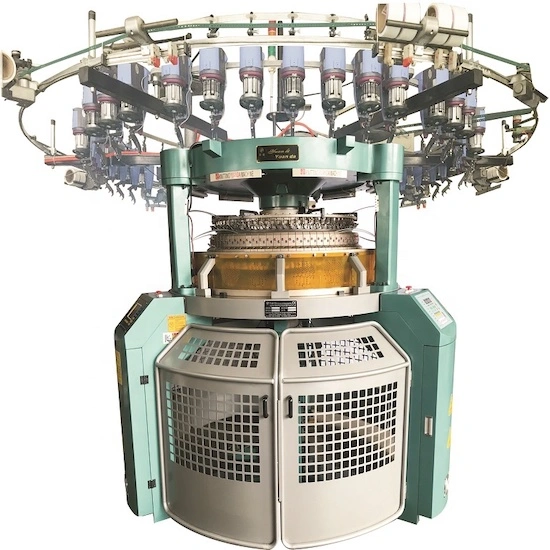
The Double Jacquard Circular Knitting Machine is designed to produce complex jacquard fabrics through advanced needle selection and electronic pattern control. Unlike conventional circular knitting machines, which rely primarily on mechanical selection systems, modern double jacquard machines integrate fully electronic controls that allow both the dial and cylinder needles to participate in pattern formation.
The machine typically features a diameter range of 26 to 42 inches and operates within a gauge range of 12 to 32, allowing manufacturers to produce fabrics with different densities and textures. It also uses a feeder configuration of approximately 1.6 feeders per inch, enabling efficient yarn feeding and high production output.
Through this configuration, the machine can produce complex double-layer knitted fabrics with detailed jacquard designs, making it suitable for both fashion-oriented textiles and functional home fabrics.
The versatility of the double jacquard circular knitting machine is supported by its flexible technical configuration. Typical specifications include:
- Machine Diameter: 26–42 inches
- Gauge Range: 12–32 gauge
- Number of Feeders: Approximately 1.6 feeders per inch
- Knitting Structure: Full jacquard double-knit fabric
- Control System: Electronic needle selection for both dial and cylinder
- Applications: Clothing fabrics, bedding textiles, pillow fabrics, children's textiles, mattress fabrics, and decorative home textiles
These specifications allow the machine to accommodate a wide variety of yarn types and fabric designs, providing manufacturers with the flexibility to meet diverse market requirements.
One of the most significant advantages of the double jacquard circular knitting machine is its full jacquard design capability. Traditional jacquard knitting machines often limit pattern creation to either the cylinder needles or mechanical selection systems. In contrast, modern double jacquard machines allow both the dial and cylinder needles to be electronically controlled, enabling full participation in the pattern formation process.
This advanced feature dramatically expands the range of possible fabric structures. Designers can create highly detailed patterns, layered textures, and unique structural combinations that were previously difficult or impossible to achieve.
By combining electronic pattern control with advanced knitting mechanisms, manufacturers can produce fabrics with:
- Intricate multi-color patterns
- Complex structural designs
- Enhanced texture variations
- Improved dimensional stability
This level of design flexibility is especially valuable for fashion brands and textile designers seeking distinctive fabrics that stand out in competitive markets.
The integration of electronic control systems represents a major technological advancement in circular knitting machinery. In the double jacquard circular knitting machine, electronic needle selection replaces traditional mechanical patterning mechanisms.
This electronic system offers several advantages:
Electronic systems enable precise control of each needle, ensuring accurate pattern formation and consistent fabric quality.
Designs can be easily programmed and modified through digital control interfaces, reducing setup time and allowing rapid design changes.
By eliminating many mechanical components used in traditional pattern selection systems, electronic controls reduce machine wear and maintenance requirements.
Automated pattern selection allows manufacturers to quickly switch between different designs, increasing productivity and reducing downtime.
As smart manufacturing becomes increasingly important in the textile industry, electronic control systems help factories transition toward digital and automated production processes.
One of the technical challenges in jacquard knitting machines has traditionally been the compatibility between the dial needle selection system and the cylinder needle selection system. Poor synchronization between these components can lead to pattern inconsistencies or mechanical inefficiencies.
The double jacquard circular knitting machine addresses this issue through an integrated control design that ensures seamless coordination between both selection systems.
This compatibility allows:
- Stable knitting operations
- Accurate pattern synchronization
- Reduced mechanical stress on needles and cams
- Improved machine reliability
Furthermore, the simplified system design makes the machine easier for operators to learn and maintain, which is particularly beneficial for factories seeking to improve operational efficiency.
The double jacquard circular knitting machine supports a wide range of textile applications thanks to its flexible knitting capabilities.
Fashion designers increasingly rely on jacquard fabrics to create visually distinctive garments. The machine can produce high-quality fabrics suitable for:
- Sweaters
- Jackets
- Sportswear
- Fashion tops
- Decorative knitwear
The growing demand for comfortable and stylish home products has increased the use of jacquard fabrics in interior textiles. The machine can produce fabrics for:
- Bed sheets
- Pillow covers
- Mattress fabrics
- Blanket materials
- Decorative household textiles
Soft and safe fabrics are essential for children's products. Double jacquard knitting allows manufacturers to create attractive patterns while maintaining comfort and durability.
Mattress fabrics require durability, breathability, and structural strength. Double jacquard fabrics provide excellent support and aesthetic appeal, making them ideal for mattress covers and bedding materials.
The adoption of double jacquard circular knitting machines offers several important advantages for textile manufacturers.
Electronic pattern control allows designers to experiment with complex textures and patterns without extensive mechanical modifications.
The machine's multiple feeders and optimized knitting mechanisms support high-speed fabric production while maintaining consistent quality.
Automated electronic controls simplify machine operation and reduce the need for extensive manual adjustments.
Digital design programming allows manufacturers to quickly test and produce new fabric designs, reducing time to market.
Precise needle control ensures consistent loop formation and pattern accuracy, resulting in superior fabric quality.
These benefits help textile factories improve competitiveness in a global market increasingly driven by innovation and customization.
Fashion trends increasingly emphasize individuality, creativity, and texture diversity. Jacquard fabrics are widely used to create visually striking garments that incorporate complex designs directly into the fabric structure rather than relying solely on printing or embroidery.
The double jacquard circular knitting machine enables manufacturers to respond quickly to these trends by producing innovative fabrics that combine:
- Rich patterns
- Dimensional textures
- Structural complexity
This capability supports the growing demand for premium knitwear in both high-fashion and everyday apparel markets.
The global textile industry is rapidly adopting smart manufacturing technologies to improve efficiency and sustainability. Double jacquard circular knitting machines can be integrated with digital production systems that monitor machine performance, yarn consumption, and fabric quality in real time.
Smart factory integration offers several benefits:
- Data-driven production management
- Predictive maintenance
- Reduced material waste
- Improved energy efficiency
As Industry 4.0 technologies continue to transform manufacturing processes, advanced knitting machines will play a central role in building intelligent textile factories.
Modern double jacquard machines are designed with ease of operation and maintenance in mind. Simplified electronic selection systems reduce mechanical complexity, while robust components ensure long-term durability.
Key maintenance practices include:
- Regular cleaning of knitting components
- Proper lubrication of mechanical parts
- Periodic inspection of needle systems
- Software updates for electronic control units
With proper maintenance, these machines can deliver reliable performance for many years, making them a valuable investment for textile manufacturers.
The development of double jacquard circular knitting machines is expected to continue evolving as manufacturers focus on innovation and efficiency.
Future advancements may include:
Higher Automation
Fully automated pattern programming and machine adjustments will further reduce manual intervention.
Advanced Digital Design Integration
Improved software tools will allow designers to create complex jacquard patterns more easily.
Sustainable Textile Production
Energy-efficient motors and optimized knitting technologies will help reduce environmental impact.
Smart Monitoring Systems
Real-time monitoring and predictive maintenance technologies will improve machine reliability and reduce downtime.
These developments will help textile manufacturers meet growing market demands while maintaining sustainable production practices.
The Double Jacquard Circular Knitting Machine represents a major advancement in textile manufacturing technology. By combining full jacquard knitting capability with electronic needle selection and advanced structural control, the machine offers unparalleled flexibility for producing complex fabrics.
Its ability to create intricate patterns, support diverse textile applications, and integrate with modern digital manufacturing systems makes it an essential tool for contemporary textile production.
From fashion apparel to home textiles and mattress fabrics, the double jacquard circular knitting machine enables manufacturers to deliver innovative, high-quality fabrics that meet the evolving needs of global markets.
As the textile industry continues to embrace automation, smart manufacturing, and design-driven production, this advanced knitting technology will remain at the forefront of fabric innovation, empowering manufacturers to push the boundaries of creativity and efficiency in the years ahead.